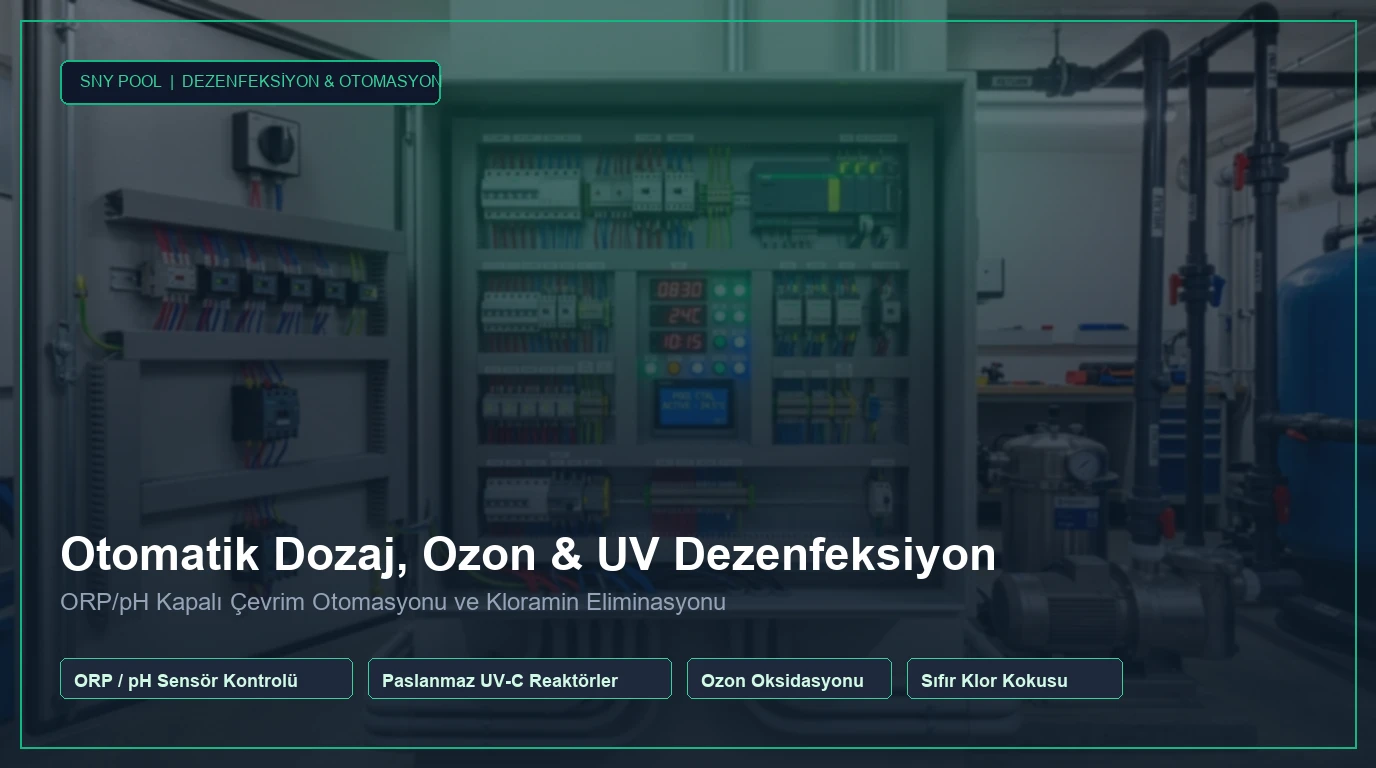
Stinging red eyes, skin irritation, and pungent 'chlorine smells' in swimming pools are not caused by free chlorine itself, but by chloramines (combined chlorine) formed when chlorine reacts with bather sweat and cosmetics, exacerbated by unstable pH. While manual chemical dosing causes volatile sanitization swings, integrating automated closed-loop ORP/pH dosing with secondary UV-C and Ozone oxidation guarantees 24/7 crystal-clear, odor-free, drinking-water quality.
How closed-loop potentiostatic ORP (Redox) and pH sensor automation works
Conventional timer-based chemical dosing pumps inject chemicals blindly, oblivious to actual bather load, sunlight UV degradation, and organic demand. This leads to dangerous under-chlorination during peak daytime use and harsh over-chlorination overnight.
In contrast, closed-loop automation passes a continuous sample stream across high-precision glass pH electrodes and platinum ORP (Oxidation Reduction Potential) sensors inside an analytical flow cell. Under DIN 19643 standards, an ORP reading between 700 and 750 mV confirms that pathogenous bacteria and viruses are neutralized within milliseconds. The microprocessor-driven controller activates peristaltic pumps to inject micro-doses of sanitizer and pH reducer only when strictly necessary, cutting annual chemical spend by up to 40%.
Destroying chloramines and Cryptosporidium via UV-C & Ozone Advanced Oxidation (AOP)
Standard chlorine disinfection alone struggles against chlorine-resistant pathogens such as *Cryptosporidium parvum* and *Giardia* cysts, which can survive in chlorinated water for up to 7 to 10 days. Furthermore, volatile chloramines (mono-, di-, and trichloramines) formed from bather sweat trigger stinging eyes, respiratory coughing, and strong chemical odors.
Plumbing inline 254 nm germicidal UV-C reactors and Ozone (O₃) injection systems into the post-filtration return line initiates Advanced Oxidation Processes (AOP). Generating ultra-reactive Hydroxyl Radicals (•OH), AOP photolytically destroys stubborn chloramines in milliseconds and scrambles parasite DNA, maintaining combined chlorine levels below 0.2 ppm for pristine, odor-free water.
AISI 316 stainless steel reactor chambers and thermal ozone compatibility
Reactor housing metallurgy is paramount in advanced oxidation systems. Plastic (PVC/ABS) chambers degrade, crack, and leak under continuous ozone exposure and high-energy UV photon bombardment.
SNY Pool manufactures disinfection reactor vessels and sensor manifolds from heavy-gauge AISI 316 stainless steel with an interior mirror electropolished finish. The reflective stainless interior bounces UV-C photons back through the water column with 85% reflectance, doubling germicidal dose efficiency while providing lifelong structural integrity.
DIN 19643 water chemistry criteria, Langelier Saturation Index (LSI), and commissioning checklist
Commissioning and water chemistry field checklist: 1) Calibrate pool water pH strictly between 7.20 and 7.40, maintaining ORP redox above 720 mV; 2) Maintain Langelier Saturation Index (LSI) between -0.3 and +0.3 to eliminate metal etching and calcium scaling; 3) Inject ozone via high-vacuum Kynar venturi with inline static mixers, pairing with residual gas-destruct mechanisms to keep ambient bather air pristine.
Browse Control Panels
Modulator panels for controlling multi-color RGB LED systems, and electrical control panels that manage pool equipment.