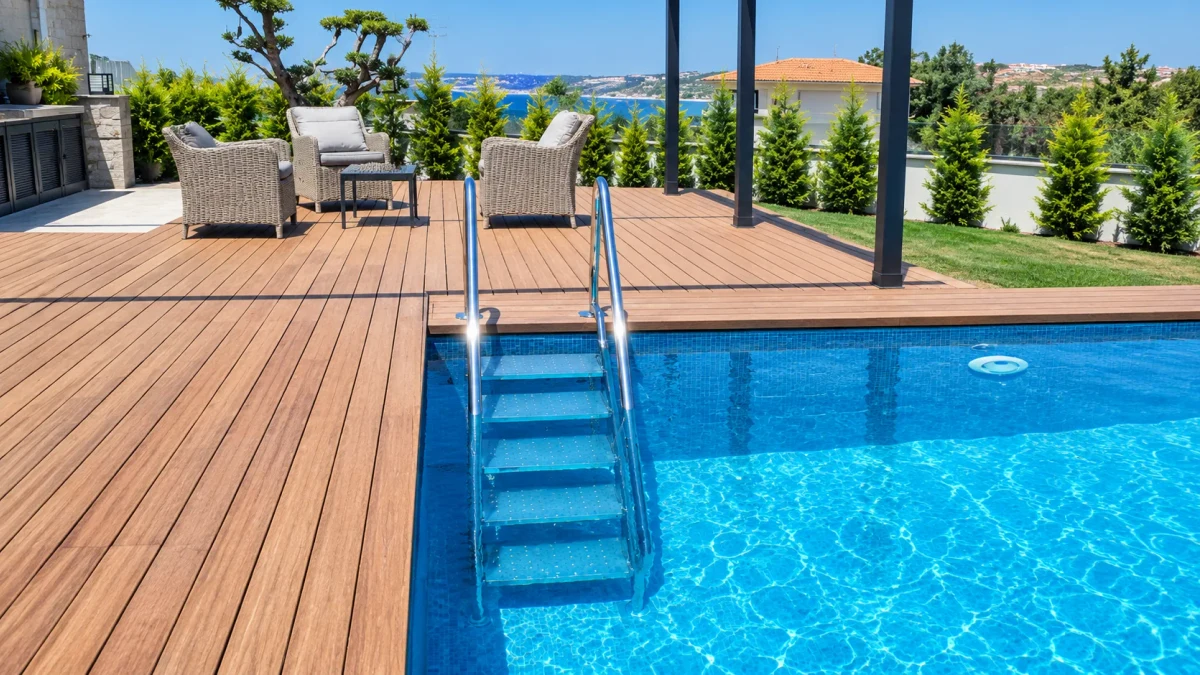
As the primary access point for safe pool entry and exit, stainless steel pool ladders must be selected carefully to prevent safety hazards and aesthetic mismatches. Choosing between Standard, Muro, and Mixto ladder designs depends directly on your pool's overflow configuration (overflow channel vs. skimmer waterline), coping width, and daily traffic intensity.
What are the structural differences between Standard, Muro, and Mixto ladder designs?
Standard Type Pool Ladders feature a generous, wide-radius handrail curve arching back from the pool edge. This provides an expansive grab area, making it ideal for residential skimmer pools with wide coping decks.
Muro Type Ladders utilize a compact, vertical-profile handrail. Because the footprint on the deck is minimal, it never obstructs the overflow drainage grilles of deck-level pools and preserves walkway clearance in tight commercial spaces.
Mixto Type Ladders offer a hybrid profile combining the ergonomic wide grip of Standard models with the flush, space-saving vertical drops of Muro ladders, delivering both comfort and streamlined underwater clearance.
How to calculate step count (2, 3, 4, 5 steps) based on pool depth
In compliance with TS EN 13451-2 pool safety standards, vertical step spacing is standardized at 250 mm (25 cm). The uppermost step should sit approximately 20 to 30 cm beneath the operational waterline so swimmers can step up comfortably without excessive knee strain.
Engineering selection guidelines: Specify 2-step ladders for shallow zones (90 – 110 cm), 3-step models for standard residential and resort pools (110 – 140 cm), 4-step models for deep recreation pools (140 – 170 cm), and 5-step configurations for diving or deep sport basins (170 – 210 cm).
Choosing AISI 304 vs AISI 316 in coastal areas and saltwater chlorinator pools
Pool ladders operate right across the harsh splash-zone interface: lower treads remain submerged while upper handrails endure aggressive chlorine vapor and direct solar heat. In coastal zones with high atmospheric salinity (such as Bodrum, Cesme, and Antalya) and pools with salt chlorinators, %2-3 molybdenum-alloyed AISI 316 marine-grade stainless steel is strictly mandatory.
For indoor or traditional chlorine residential pools, AISI 304 provides dependable corrosion defense and superior value. All SNY Pool ladders are manufactured from heavy-duty Ø42.4 mm or Ø43 mm stainless steel tubing with mirror-polished finish that resists scale accumulation and biofilm.
Flanged vs. anchored installation: Setup criteria for concrete, overflow, and liner pools
Two primary mounting methods exist: in-ground plastic anchor sleeves embedded during deck concrete pouring, and external stainless steel surface-mount flanges anchored into finished stone. Anchor sleeves allow swift, tool-free removal and winter storage.
For liner (PVC membrane) pools, the underwater ladder bumpers must feature soft rubber stoppers to protect the delicate waterproof liner membrane from mechanical abrasion and puncture.
Browse Stainless Ladders
Standard, Muro and Mixto type stainless pool ladders. Hydrotherapy and jetty ladders.